
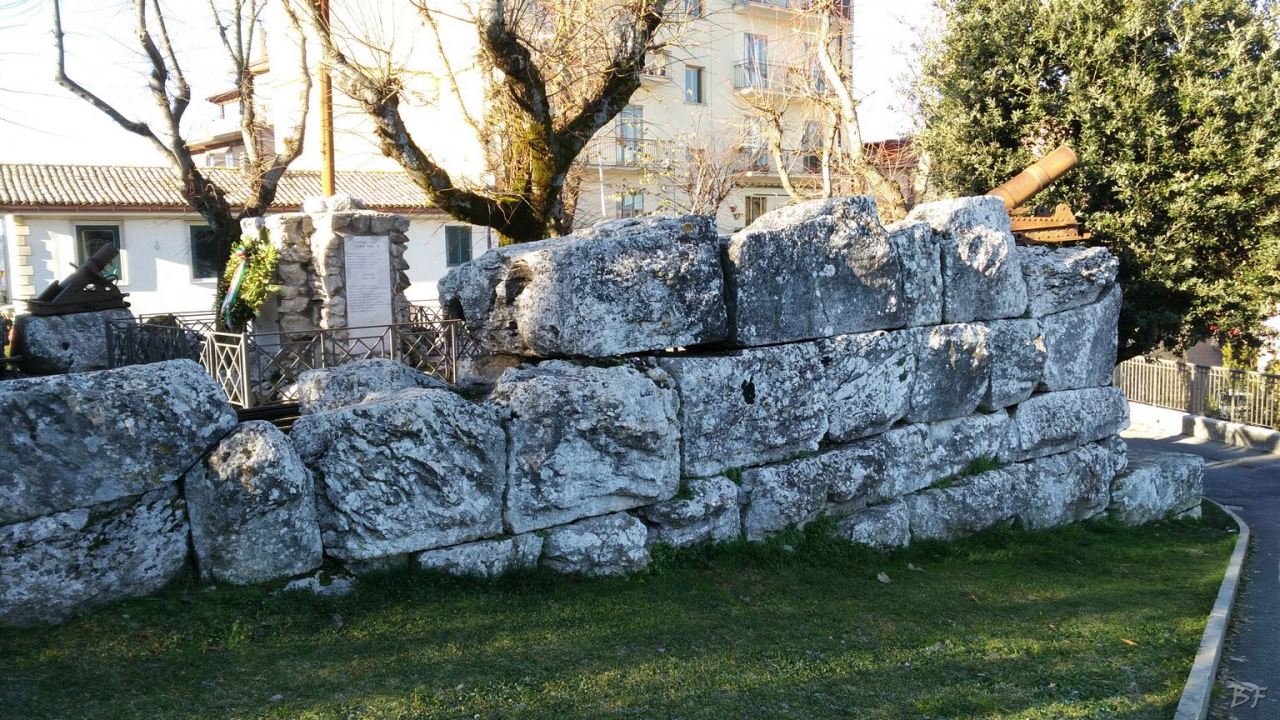
Cyclopean Polygonal Walls
The cyclopean walls of Bellegra are one of those places that, rather than imposing themselves with the spectacularity of a monumental ruin, slowly work on the gaze. At first, one only sees large stones: massive, pale limestone blocks, marked by time, arranged along the edge of the village and at the base of the municipal gardens. Then, stepping closer, it becomes clear that those stones are not there by chance. Each boulder has a different shape, every joint tells a story of adaptation, and every gap filled with smaller stones reveals a technical solution. This is the charm of polygonal masonry: a construction born without mortar, without cement, without the reassuring regularity of bricks, yet capable of resisting for centuries thanks to the balance between weight, interlocking, and knowledge of the material.
The name “”cyclopean walls”” belongs more to popular imagination than to archaeological terminology. It stems from the ancient idea that such imposing works could not have been built by ordinary men, but by gigantic creatures, the Cyclopes. In reality, the more correct term is “”polygonal walls””: it refers to a building technique widespread in ancient central Italy, especially where limestone was available and could be quarried, rough-hewn, and adapted into irregular blocks. One should not imagine it as primitive masonry in the banal sense of the word. On the contrary, it was a precise, practical technology, suited to slopes and summits, designed to fortify, contain, support, and mark the boundary between the settlement and the surrounding landscape.
In Bellegra, these walls hold a particular value because they connect the current town with its most remote origins. The village is situated on Mount Celeste, over eight hundred meters above sea level, in a position that dominates the territory between the Aniene Valley and the Sacco Valley. Today, this height is primarily a panoramic privilege: open air, wide horizons, mountains that seem to arrange themselves in a circle. In antiquity, however, it was primarily a strategic position. Being high up meant seeing anyone approaching early, controlling passages, defending a settlement, and negotiating—or clashing—with neighboring communities. Local tourist and historical sources link Bellegra to ancient Vitellia, a center remembered in tradition as being contested between Italic populations and Rome. It is a fascinating identification, to be treated with caution when entering the realm of ancient sources, but it conveys the idea of a borderland: not peripheral, but exposed, traversed, and contested.
An episode often recalled by local scholars concerns Vitellia and the memory of Livy, who, in his narrative of Coriolanus’s march, mentions a city by this name among the centers struck by the Volscian advance. This is not an anecdote to be transformed into absolute certainty, but it serves as a useful historical suggestion: it reminds us that these places, silent and gathered today, belonged to a lively political geography, made up of small fortified centers, shifting alliances, and recurring conflicts.
The most interesting thing when observing the walls is that they do not all belong to the same period. Available descriptions distinguish at least two techniques. The first is attributed to the 7th and 6th centuries BC: rougher blocks, less tightly fitted, with interstices often filled by smaller stones. It is a masonry that retains something rough, almost geological, as if the wall were an artificial continuation of the mountain. The second phase, dated between the 3rd and 2nd centuries BC, shows greater mastery instead: the blocks are more regular, better squared, and organized along tidier lines; the interlocking becomes more precise, and small wedges are used to close the remaining spaces. In this difference, a long history can be read, made of adaptations, rebuildings, and perhaps new political and military needs.
From an architectural point of view, these walls are also important because they do not merely separate: they build a relationship between nature and the city. In Bellegra, the wall is not an isolated element, enclosed in an archaeological area distant from daily life; it is integrated into the town, next to public spaces, close to the paths of the center, almost like a silent base upon which the village has continued to grow. The ancient stones are not under a glass case: they coexist with railings, streets, viewpoints, and gardens. This makes the site less “”museum-like”” but perhaps more understandable. It shows us that Italian towns are often built in layers: a modern settlement retaining a medieval name, Civitella, used for centuries before the current Bellegra; a village guarding Roman and pre-Roman memories; a landscape that continues to explain the reasons for its history.
The artistic effect arises precisely from this continuity. The polygonal blocks have no decorations, no bas-reliefs, and tell no scenes. Their beauty lies in their material measure: in the tension between irregularity and order, in the limestone surface worn by rain and sun, in the mass that seems heavy and yet necessary. They are walls that do not ask to be admired like a palace or a church, but to be read. And if read carefully, they say something simple and powerful: long before the squares, facades, bell towers, and streets, Bellegra was a high point to be defended, a place chosen because it looked far ahead. Its cyclopean walls are the most concrete trace of this ancient choice: enormous stones, leaning against each other, that still hold together archaeology, landscape, and identity today.